CLARITY Act 2026 Explained: The Pros, Cons & What It Means for Crypto
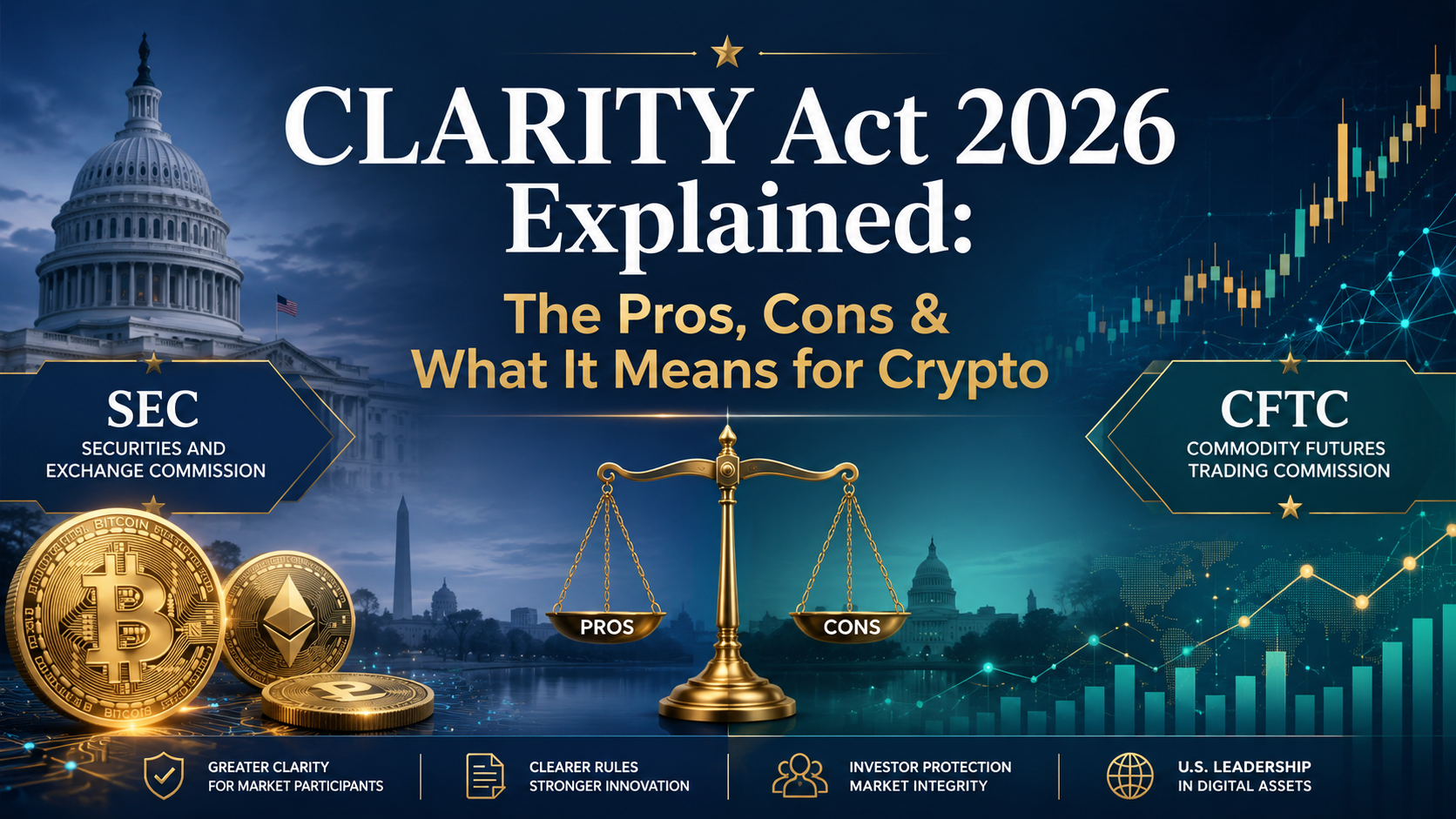
At first, like many people, I didn't know what the CLARITY Act was all about, so I decided to do my research to better understand it and explain it in simple, straightforward terms.
The CLARITY Act is a proposed U.S. law designed to create a clearer rulebook for cryptocurrencies and digital assets.
Basically, Washington is finally trying to answer one giant question:
Who the heck is actually in charge of crypto? 😂

What Is the CLARITY Act For?
Right now, the government has spent years debating what different cryptocurrencies actually are.
Are they a commodity, like gold?
Are they a security, like stock in a company?
Are they something completely different?
Who the heck knows?
Almost all of us know that they're digital assets.
And honestly, once regular money goes into a bank account, isn't most of that digital too? 🤔
We swipe cards, transfer money electronically, use apps, and rarely touch actual cash.
Either way, one thing never changes:
We still have to pay taxes when required.
It never fails. 😂
But crypto has another problem.
Companies, investors, developers, exchanges, and regular users have spent years trying to figure out which rules apply to them.
The CLARITY Act is supposed to help change that.
🐕🦺 Who Would Watch Over Crypto?
One of the biggest goals of the CLARITY Act is to divide responsibilities between two major government watchdogs:
The CFTC, which already oversees commodity markets, would receive authority over many digital commodities and decentralized crypto assets.
The SEC, which oversees securities markets, would continue regulating digital assets that qualify as securities.
In other words, instead of everybody arguing over the same bone, the government wants to tell each watchdog which part of the yard belongs to them. 😂

So, How Could This Benefit the Public and Investors?
✅ Pro: Clearer Rules
This is probably one of the biggest benefits.
Crypto companies would have a clearer idea of which laws they need to follow and which government agency regulates them.
Legitimate businesses may actually welcome this.
Why?
Because operating in a market where nobody knows exactly what the rules are can get expensive very quickly.
Clearer regulations could make it easier for businesses to build products, raise money, serve customers, and stay in the United States instead of moving somewhere else.
As for the shady companies?
Well...they may not be quite as excited. 🤷♀️
✅ Pro: Safer Exchanges
Now this one makes sense.
Crypto trading platforms would face stronger rules involving customer assets and business funds.
The goal is to reduce situations where a company quietly uses customer deposits for its own purposes.
After watching several major crypto companies collapse over the years, I think most people can agree:
Please keep my money away from your company piggy bank.
✅ Pro: More Transparency
Crypto projects could also face stronger disclosure requirements.
That means companies may have to explain more clearly:
What the project actually does
Who controls it
How tokens are distributed
What risks investors face
How the project operates
Basically:
Tell people what they're actually buying.
What a concept! 😂
✅ Pro: Stronger Fraud and Market Manipulation Rules
The bill would also expand oversight of digital commodity trading.
That could give regulators more authority to go after fraud, market manipulation, and questionable trading practices.
It won't eliminate scams.
Nothing will.
But having clearer rules makes it harder for someone to shrug and say:
“Well, technically nobody regulates this.”

This is where things get more complicated.
There are definitely potential downsides.
❌ Con: The CFTC Is Smaller Than the SEC
Some critics argue that the CFTC may not have enough funding or staff to supervise a rapidly growing crypto market.
Crypto operates 24 hours a day.
Every day.
Everywhere.
That's a pretty large digital zoo to police.
If lawmakers give the CFTC significantly more responsibility without giving it enough resources, enforcement could become difficult.
❌ Con: The Rules Could Still Get Confusing
One of the biggest debates involves determining when a crypto asset becomes decentralized enough to fall under one regulator instead of another.
And that's where things can get messy.
Who decides when a token has crossed that line?
How decentralized is decentralized enough?
What if a project starts centralized and gradually becomes decentralized?
Lawyers are probably already rubbing their hands together. 😂
❌ Con: Compliance Could Be Expensive
Larger crypto companies can afford teams of attorneys, compliance specialists, cybersecurity experts, and accountants.
Smaller projects?
Not always.
New regulations could make the industry safer, but they could also increase the cost of launching legitimate crypto projects.
That could unintentionally favor giant companies over smaller developers.
How Could the CLARITY Act Affect DeFi?
This is where things get especially interesting.
DeFi stands for decentralized finance.
Instead of relying completely on traditional banks or financial companies, DeFi applications use blockchain networks and smart contracts to allow people to trade, lend, borrow, stake, or move digital assets.
The CLARITY Act includes important protections involving self-custody and decentralized technology.
✅ Pro: Protecting Self-Custody
Self-custody means you control your own wallet and private keys.
Think wallets such as:
MetaMask
Trust Wallet
Ledger
Other self-custody wallets
This matters because one of the original ideas behind crypto was to let people control their own digital assets without needing a bank or centralized company to hold everything for them.
✅ Pro: Protecting Developers
The legislation also includes protections for certain developers who create or publish decentralized software.
That's important because writing open-source code is different from actually running someone's financial account.
Developers have argued for years that they shouldn't automatically be treated like financial institutions simply because they created software people use.
✅ Pro: Decentralized Protocols Aren't Traditional Banks
Truly decentralized software may not be able to collect customer information the way Coinbase, a bank, or another centralized company can.
So regulations have to recognize the difference between:
software
and
a company controlling customer transactions.
That distinction could become extremely important as DeFi grows.

But What's the Catch With DeFi?
Of course there is one. 😂
❌ Front-End Websites Could Face More Rules
The blockchain protocol itself might be decentralized.
But the website you visit to access it may still be operated by a company.
That's where regulators may focus more attention.
Those businesses could eventually face additional anti-money-laundering, cybersecurity, disclosure, or compliance requirements.
So the decentralized code might remain open...
while the website sitting on top of it becomes much more regulated.
❌ Regulated Companies Connecting to DeFi Could Face More Responsibility
Businesses that help customers access DeFi may also have greater responsibilities involving fraud, cybersecurity, and market manipulation.
That could potentially protect users.
But it could also mean more identity verification, restrictions, or unavailable features depending on where you live.
A Real-World Example: Ether.fi
This is where apps such as Ether.fi become interesting.
Ether.fi combines several parts of the crypto world, including staking, DeFi, crypto spending, and other financial tools.
That doesn't make Ether.fi the focus of the CLARITY Act.
But it does show why regulatory clarity matters.
Imagine an app offering:
staking + crypto wallets + DeFi + payments + a card + rewards
Now ask:
Which government agency regulates each part?
What rules apply?
Does the answer change depending on whether you're using a decentralized protocol or a company-operated service?
Does it change depending on what state you live in?
That's exactly the type of regulatory puzzle lawmakers are trying to solve.
And we're already seeing companies limit certain crypto features depending on where users live.
So when people hear politicians arguing about “crypto market structure,” it may sound boring.
But eventually those rules could determine:
which crypto apps you can use, what features they can offer, and how those companies are required to protect your money.
That's why the CLARITY Act matters beyond Bitcoin prices.
READ MORE ABOUT ETHER.FI: A CRYPTO SUPER APP
What About Stablecoin Rewards?
Stablecoins add another layer to this whole thing.
Stablecoins are cryptocurrencies designed to maintain a relatively stable value, usually around $1.
They've become extremely important in DeFi because people use them for trading, payments, lending, borrowing, and earning yield.
Other legislation, including the GENIUS Act, has also addressed how stablecoin issuers operate.
One major debate involves yield and rewards.
There is an important difference between:
earning interest simply because you're holding a stablecoin
and
earning a return because you deposited that stablecoin into a separate DeFi protocol.
Those distinctions matter because regulators may treat each activity differently.
Expect this area to keep evolving.
💩 Now Let's Talk About Poop Coins
Yes.
The beloved meme coins.
Thousands upon thousands of tokens featuring dogs, frogs, cats, politicians, internet jokes, and probably at least one confused hamster.
The SEC has previously said that certain types of meme coins generally do not qualify as securities. Poop coins (meme coins) will be classified as digital collectibles.
Meme coins will be grouped with other digital collectibles like NFTs and Artwork Tokens. Because their value is based on internet hype, jokes, and culture rather than a real development team or business entity, the law treats them more like baseball cards than a true investment.
That doesn't mean every token calling itself a meme coin automatically escapes regulation.
You can't slap a cartoon dog on something and suddenly yell:
“NOT A SECURITY!”
Nice try. 😂
Regulators can still look at how a token was created, marketed, sold, and controlled.
✅ Pro: Meme Coins May Avoid Expensive Securities Registration
If a meme coin truly doesn't qualify as a security, its creators wouldn't have to follow the same securities-registration process as a company selling traditional investments.
That could preserve the weird, chaotic, community-driven part of crypto that people clearly enjoy.
Because let's face it:
The internet is never going to stop creating ridiculous coins.
❌ Con: Less Regulation Can Mean Less Protection
Here's the other side.
If your meme coin crashes because everyone suddenly decides the joke isn't funny anymore...
the government isn't going to reimburse you.
If you buy something highly speculative and its value drops to zero, that's still investment risk.
Regulation can fight fraud.
It cannot prevent bad decisions.
It also cannot force someone to keep buying:
SuperMegaElonDogPoopCoin9000.
At some point, you're on your own. 😂
Will the CLARITY Act Pass?
As of August 19, 2026, the legislation is still moving through Congress.
The House passed its version of the CLARITY Act in July 2025.
The Senate has continued working on its own crypto market-structure legislation, with lawmakers debating areas including DeFi, stablecoins, regulatory authority, investor protections, and other issues.
President Donald Trump also met with crypto-industry leaders at the White House on August 19, 2026 and pushed lawmakers to move forward with crypto market-structure legislation.
So no final CLARITY Act has been signed into law yet.
But the bill isn't dead either.
And considering how much money, technology, and political attention is now moving into digital assets, I don't think this issue is going away.

So What Can We Expect?
If some version of the CLARITY Act eventually becomes law, I think the biggest change may simply be this:
Crypto starts growing up.
Not becoming boring.
Hopefully. 😂
But becoming more structured.
We could see clearer rules for exchanges.
More protections around customer assets.
Better disclosures.
Clearer boundaries between the SEC and CFTC.
More defined protections for self-custody and decentralized technology.
And hopefully fewer opportunities for companies to operate inside giant regulatory gray areas.
There will still be risks.
There will still be scams.
There will still be hacks.
There will definitely still be poop coins. 💩
But clearer laws could make it easier to separate legitimate innovation from businesses simply taking advantage of confusion.
And that's why I'm watching the CLARITY Act.
Because this isn't really just about Bitcoin, Ethereum, meme coins, or crypto exchanges.
It's about deciding what the next version of our financial system is allowed to look like.
And we may only be seeing the beginning of it. 👀
This article is for educational and informational purposes only and should not be considered financial, investment, tax, or legal advice. Cryptocurrency and DeFi involve significant risk, and regulations can change.
References: www.skadden.com www.goverance-intelligence.com, www.congress.gov, www.avemarialaw.edu, joincenter.org, empower.com, https://finance.yahoo.com
Thank you for subscribing!
Have a great day!
Affiliate Notice: Some links in this article may be affiliate links. If you sign up or use a service through one of these links, I may receive a commission or reward at no additional cost to you. Affiliate relationships do not change my opinions. Cryptocurrency and DeFi involve risk, and rewards, rates, availability, and token values can change.