|
Card |
Travel Rating |
Why |
|---|---|---|
|
9/10🥇 |
|
|
|
8.5/10🥈 |
Self-custody, stablecoin spending, strong travel perks, global Mastercard use; Metal has no foreign transaction fees, but is unavailable to U.S users. |
|
|
8.5/10🥈 |
Very easy for U.S. users, USDC spending, worldwide Visa acceptance, no Coinbase ATM fee. |
|
|
7.5/10🥉 |
Excellent debit/credit flexibility and NEXO rewards, but unavailable to U.S. cardholders and FX fees can be significant |
|
|
7/10🥉 |
Mature ecosystem and CRO rewards, but lower U.S. tiers have a painful 3% foreign transaction fee |
Crypto Cards for Travelers: Can Crypto Make Traveling Easier?
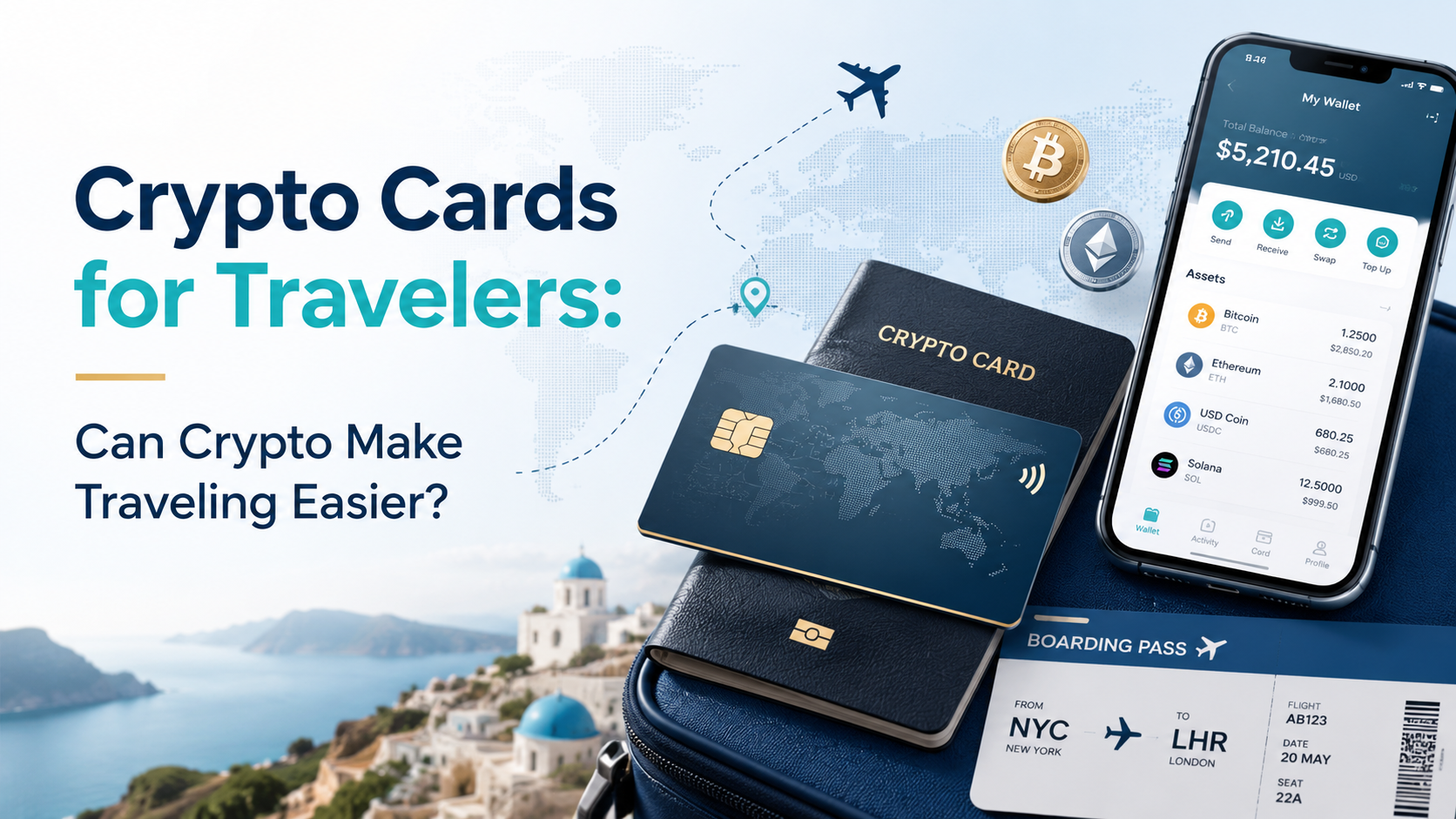
Traveling internationally usually means thinking about exchange rates, foreign transaction fees, ATM charges, Booking Fees, and how much cash to carry.
But what if part of your travel wallet could run on crypto?
Crypto cards are becoming an interesting option for travelers who already own cryptocurrency or stablecoins and want an easier way to use those funds in the real world. Instead of searching for a restaurant, hotel, or store that accepts cryptocurrency directly, many crypto cards work through familiar payment networks such as Visa or Mastercard. What a plus!
That means you may be able to buy lunch in Paris, pay for a train ticket in London, or check into a hotel while the crypto card handles all the conversion behind the scenes. Just swipe and go!
But listen, crypto cards are still evolving, and they are definitely not all created equal.
So I decided to do some research and find which crypto cards are good options for traveling with and why.
First…

What Is a Crypto Card?
A crypto card is a debit, prepaid, or credit-style card connected in some way to cryptocurrency or digital assets.
Depending on the card, you might:
Spend stablecoins such as USDC
Convert Bitcoin, Ethereum, or another cryptocurrency when making a purchase
Borrow against crypto instead of selling it (a great option to have)
Load a card balance using crypto
Earn cryptocurrency or stablecoin rewards when you spend (a good plus)
However, merchants usually don't have to accept crypto.
The card provider handles all the conversion, and the merchant receives regular local currency through the payment network.
Mastercard describes crypto cards as a bridge between digital assets and traditional payment systems, allowing cardholders to spend crypto while merchants continue receiving normal fiat currency.
For us travelers, that bridge makes things much more interesting.

Why Would a Traveler Want a Crypto Card?
The biggest attraction is convenience.
The last thing you want to worry about is moving cryptocurrency to exchange it, sell it, or transferring dollars to your bank to use your debit card. Crypto cards make this process go away and make your financial flow a lot better.
You may be able to go directly from:
Crypto → Card → Purchase → DONE!
This process can be very useful for travelers who already keep part of their money in stablecoins or other digital assets.
And the market is growing quickly. Visa reported that stablecoin-linked cards processed roughly $5.2 billion in volume during 2025, up 319% year over year. Wow, that's major, and one day it will probably become the normal (only) way!
So this isn't just a tiny crypto experiment anymore.
Stablecoins May Be More Useful for Travel Than Volatile Crypto
Here is one important message travelers should understand.
There is a big difference between spending Bitcoin on vacation and spending a dollar-backed stablecoin such as USDC.
Imagine buying a $200 dinner using Bitcoin and then watching Bitcoin rise 10% a week later.
Suddenly, that was an expensive dinner.
Stablecoins keep their value close to a currency like the U.S. dollar, making them easier to use for trip budgeting.
Instead of asking:
"How much Bitcoin did I just spend?"
you can think:
"That hotel cost me approximately $180."
For travelers who want the convenience of crypto without turning every cappuccino into a miniature investment decision, stablecoin-based spending can make much more sense.

A Few Crypto Cards Travelers May Come Across
Quite a few crypto cards are floating around, with new ones springing up. However, after doing some research, I want to share a few crypto cards worth knowing about right now.
ether.fi Cash
The ether.fi Cash card is particularly interesting from a travel perspective because ether.fi has been building travel features around the card itself.
The card can be used anywhere Visa is accepted globally, subject to eligibility and regional restrictions. ether.fi also offers physical and virtual cards, Apple Pay and Google Pay support, crypto-backed spending, and cashback on qualifying purchases. It also offers simple ways to add cash to buy stablecoins or other digital assets.
One feature that caught my attention is its treatment of euro purchases.
ether.fi says eligible EUR purchases currently receive zero additional FX markup, whether the spending asset is USDC or EURC. The feature is currently described as being in beta.
For other currencies, foreign-exchange costs can still apply, and the exact amount depends partly on membership tier.
ether.fi has also launched ether.fi. Travel, which lets Club members search for hotels and flights within its ecosystem with discounts up to 60%. The company currently advertises 5% cashback on qualifying hotel bookings paid with the ether.fi Cash card.
That combination of crypto spending + travel booking + rewards makes ether.fi one of the more interesting examples of where crypto travel could be heading.
Coinbase Card
For U.S. crypto users looking for something straightforward, the Coinbase Card is another option.
Coinbase says its prepaid Visa card can be used at merchants worldwide that accept Visa debit cards. U.S. users can spend cash or supported crypto and earn rotating crypto rewards on eligible purchases. Coinbase currently advertises no annual fee or spending fees, although other conversion or transaction considerations may apply depending on how the account is funded.
This may appeal to someone who already uses Coinbase and doesn't want to open another crypto ecosystem just for traveling.
Crypto.com Card
The Crypto.com Visa Card is probably one of the better-known crypto-linked cards.
It has different card levels, each with different benefits and fees.
This is where travelers really need to read the fine print.
For U.S. cardholders, Crypto.com currently lists a 3% foreign transaction fee on non-USD purchases for its Midnight, Ruby, Jade, and Indigo tiers. Its Rose, Icy, and Obsidian tiers currently list no foreign transaction fee. ATM allowances and fees also vary by tier.
That doesn't necessarily make the card good or bad.
It simply shows why travelers shouldn't choose a crypto card based on cashback alone.
A shiny reward can disappear remarkably quickly if you're paying a 3% currency-conversion fee every time you tap your card.
MetaMask Card
MetaMask states the card can be used anywhere Mastercard is accepted, even in countries where you can't sign up for the card.
One of its biggest advantages is that you don't have to move your crypto into a centralized exchange account before your trip. You choose which tokens the card is allowed to use, set a spending cap, and your assets stay in your MetaMask wallet until you make a purchase.
Save up to 60% on hotels and earn rewards in $FLY.
USDC in MetaMask → tap MetaMask Card → merchant receives euros/yen/pesos/etc
The Metal card is where travel gets interesting
For international travel, I would lean toward Metal rather than the free card.
MetaMask's current fee schedule lists a 1% cross-border charge on the free tier, while the Metal tier has no cross-border fee, subject to its fair-use terms.
MetaMask offers a rewards program too. Here are 250 points when you get started.
Nexo Card
Nexo's card can work as both a debit and a credit card.
Its travel usefulness also depends heavily on location.
Nexo mainly supports cards in European countries, including the EEA and UK. Foreign exchange fees differ by region and whether the transaction is on a weekday or weekend.
That makes Nexo much more relevant to some European travelers than to someone living in the United States.
And that brings us to one of the biggest rules of crypto cards:

Check Where the Card Is Available BEFORE Falling in Love With It
Crypto card websites can make a product look wonderfully global.
The reality is often more complicated.
A card might:
Work internationally but only be issued to residents of certain countries
Offer a virtual card in one country but not a physical one
Have different rewards depending on your region
Restrict ATM withdrawals in particular locations
Require identity verification
Change banking or card-issuing partners
Crypto card availability changes more frequently than most traditional credit-card programs.
Always check the provider's current eligibility page before signing up.
The Travel Fee Nobody Should Ignore: Foreign Exchange Fees
Travelers should pay close attention to FX fees, sometimes called foreign transaction or currency-conversion fees.
A card offering 2% crypto cashback isn't especially exciting if you're simultaneously losing 3% on foreign purchases.
Traditional travel-card advice still applies here.
Foreign transaction fees can commonly reach around 3%, and travelers should also watch out for something called Dynamic Currency Conversion, or DCC.
DCC is when a payment terminal abroad asks something like:
Pay €92
OR
Pay $109 USD
Choosing dollars may feel safer because you recognize the amount immediately.
But the merchant's conversion rate can be worse.
In many situations, choosing the local currency and letting your card network perform the conversion can result in a better rate.
Even Ether.fi specifically warns its cardholders that DCC can produce less favorable exchange rates.
So if you're in France, choose euros.
If you're in Japan, choose yen.
If you're in Mexico, choose pesos.
Let the card do its job.
🏧 What About Using Crypto Cards at ATMs?
Some crypto cards also allow ATM withdrawals.
That’s useful when traveling where cash is common.
But look at three different fees before relying on it:
Your crypto card provider's ATM fee
The local ATM operator's fee
Any currency-conversion or FX fee
There may also be monthly free-withdrawal limits.
For example, Crypto.com's current U.S. ATM allowances vary by card tier, and a 2% charge applies to withdrawals above the applicable monthly free limit.
So I wouldn't make a crypto card my only way of getting cash abroad.
Hotels and Rental Cars Can Be Tricky
Here's another travel detail that is easy to overlook.
Hotels, rental-car agencies, and gas stations commonly put temporary authorization holds on cards.
Your $250 hotel stay might temporarily require substantially more than $250 of available spending capacity.
Crypto.com specifically warns cardholders about these higher preauthorization amounts for hotels, car rentals, gas stations, and certain other merchants.
This is one reason I would still travel with a traditional credit card alongside a crypto card.
Your crypto card can be useful for everyday purchases.
Your regular travel credit card can handle hotel deposits, rental cars, and emergencies.
Think of them as travel teammates, not mortal enemies.

🪙 What About Crypto Rewards?
Rewards are one of the fun parts.
Depending on the card, you may receive:
Bitcoin
USDC
Ethereum
A platform token
Cashback
Travel benefits
Lounge-related benefits
Higher rewards based on membership level
But don't chase the biggest percentage without checking what's underneath it.
A 5% reward connected to an expensive subscription, token-staking requirement or high FX fee might ultimately be worse than a simple 1% card with no foreign transaction fee.
The number on the billboard isn't always the number that reaches your wallet.
Don't Forget About Taxes
This is the decidedly less glamorous member of the travel party.
Depending on your country, spending cryptocurrency can potentially create a taxable disposal.
For example, if you purchased cryptocurrency for one value and it increased before you spent it, converting or spending that cryptocurrency could potentially create a capital gain.
Kraken notes that spending through crypto debit cards may constitute a taxable event depending on the jurisdiction.
That is another reason some travelers may prefer spending stablecoins instead of frequently selling appreciated Bitcoin or Ethereum.
Tax rules vary by country, so this is one area where professional tax guidance may be worthwhile.

💰 Borrowing Against Crypto Instead of Selling It
Some crypto cards, such as ether.fi Cash and Nexo Card, can let users borrow against eligible crypto rather than selling it to pay for purchases.
Why does that matter? In the U.S., selling or spending appreciated crypto can potentially create a taxable capital gain. Borrowing against crypto generally does not create a taxable sale by itself because you still own the underlying asset.
For example, instead of selling ETH to pay for a hotel, you might use ETH as collateral and borrow funds for the purchase while keeping your ETH invested.
This can be useful for travelers who hold appreciated Bitcoin or Ethereum and don't want to sell every time they need spending money. However, crypto-backed borrowing comes with interest costs and liquidation risk if the collateral value falls too far.
For everyday travel spending, stablecoins such as USDC may still be simpler. Borrowing is most interesting when the goal is to access the value of long-term crypto holdings without selling them immediately.
Tax treatment depends on your individual situation and the structure of the card or loan. Consult a qualified tax professional for personal guidance.
What I Would Look for in a Crypto Travel Card
If my goal were specifically international travel, my checklist would be:
Low or zero foreign transaction fees
This would be near the top of my list.
Stablecoin support
I would prefer the ability to spend USDC, EURC or another stable-value asset rather than automatically selling long-term investments.
Wide Visa or Mastercard acceptance
The card isn't very useful if merchants can't process it.
ATM access
Even better if the card includes a reasonable amount of fee-free withdrawals.
Virtual card + mobile wallet
Being able to add the card to Apple Pay or Google Pay before the physical card arrives can be extremely useful.
Easy card freezing
If my phone or wallet disappears somewhere between Barcelona and baggage claim, I want to lock that card immediately.
Transparent conversion rates
Crypto cards already have enough moving parts. Mystery fees don't need an invitation.
Useful rewards
Rewards are wonderful, but only after the fees, limits, and usability make sense.
Would I Travel With Only a Crypto Card?
No.
At least not yet.
I like the idea of crypto cards for travel, particularly cards that make stablecoins easier to spend internationally.
But I would still carry:
One crypto card
One traditional credit card with no foreign transaction fee
A regular debit card
A small amount of local cash
That gives you several financial escape hatches if one account gets frozen, a terminal rejects your card, your phone dies, or a particular payment network isn't accepted.
International travel has a remarkable talent for finding the one payment method you forgot to bring.

Crypto Cards Could Become Much More Important for Travelers
This may be one of crypto's most practical use cases.
Not another token.
Not another chart.
Not another project promising to revolutionize absolutely everything by Thursday.
Just the ability to hold digital money and actually use it.
Visa says stablecoin-linked cards are already connecting digital wallets with everyday merchants worldwide, and stablecoin card activity has been growing quickly.
For travelers, this could mean using a digital wallet to manage money, move between countries, pay in local currencies, earn rewards, and avoid some of the usual hassles of international money transfers.
We're not completely there yet.
Fees still vary. Regulations vary. Card availability varies. Tax rules matter.
But crypto cards are beginning to look less like a novelty and more like another tool travelers can place in their financial carry-on.
And that is where crypto starts getting much more interesting to me: when it stops being something we simply hold and starts becoming something we can actually use.
References: nexo.com, cryto.com, ether.fi, metamask.io, coinbase.com, mastercard.com, visa.com, kraken.com
Disclaimer: This article is for educational purposes only and is not financial, tax, investment or legal advice. Crypto products, rewards, fees and geographic availability can change. Always confirm current terms directly with the card provider before applying or traveling.
Affiliate Notice: Some links on this page may be affiliate links. If you sign up or make a purchase through one of these links, I may earn a commission or reward at no extra cost to you. I only share programs and opportunities I believe are worth researching. Always do your own research before making financial decisions.
Thank you for subscribing!
Have a great day!